I admit it. I can’t keep up with the sheer volume of people, places, events and experiences in this trip. I have an iPhone full of notes that never get turned into blogs because we are always onto the next thing. Consequently, I am playing catch-up. But where to start? Should it be the week-long cycle tour we’ve just done from the Atlas Mountains to the Sahara? Or should I write about dealing with broken suspension in a field in the High Atlas? Or dramatic arrests in Western Sahara? I’ll get to everything eventually but I have to start somewhere and I am waaay behind. So to pick up from where I left off…
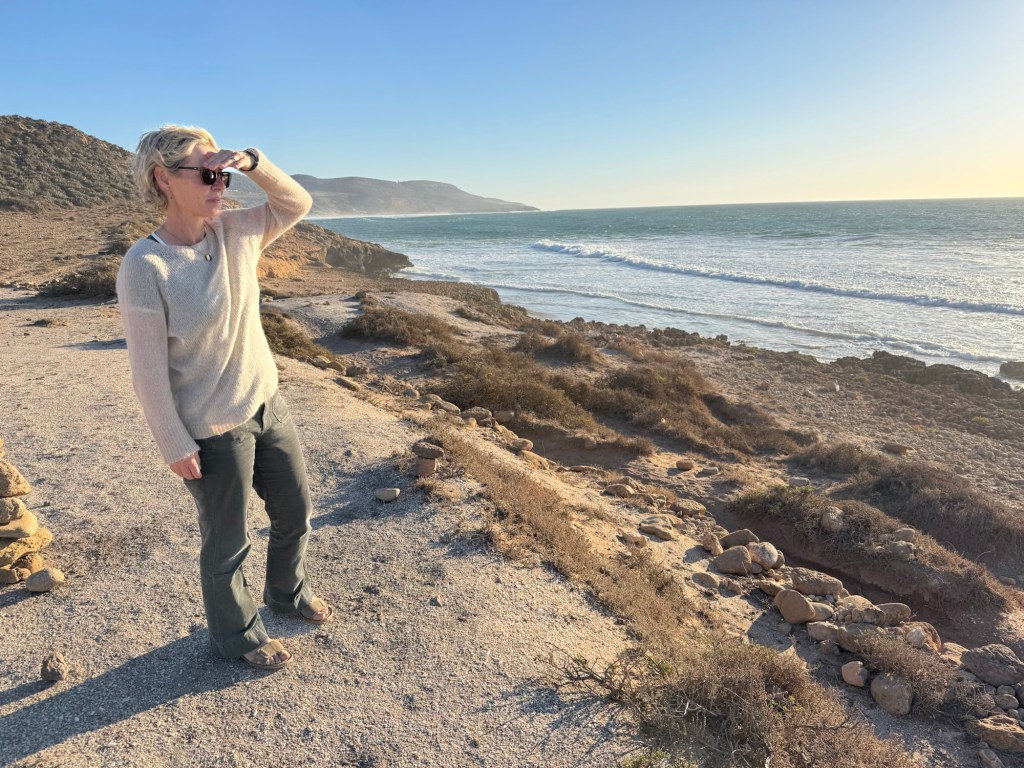
The road which hugs the coast south from Essaouira is rough enough to dispense with most tourists. It is a dusty, unpaved track which moves serpent-like over the cliff along the shoreline; twisting, rising and falling with a substantial drop to the wide blue ocean on one side and groves of olive and argon on the other, concealing isolated small farms. It makes for a lonely, windblown journey and the track was so tight that it was surprisingly hard to find a place to pull off to spend the night. In an effort to find one, we diverted on to an even narrower, bumpier track which became increasingly precarious but also gave us a view of a fishing village in a haze of sea spray way below us – Sidi Ahmed. We drove on until we could turn Arnie around without sliding into the sea and then we found the zigzag track down to the beach. The bottom section was the steepest and roughest; Arnie dug in and slipped only a little, watched by a couple in a white-box camper on the beach who were clearly questioning the wisdom of their driving choices. They gave us white-faced smiles and the woman in the passenger seat crossed herself. As we got to beach level, the driver floored the camper and got part way up the first section until the wheels span and he had to reverse back down. The second attempt was more successful; the rear end shimmying for grip and spitting stones until they finally got traction and bounced back up the cliff side.
A man spotted us and ran over to move his moped so we could park. He beamed and waved. Arnie does seem to have that effect on people here.
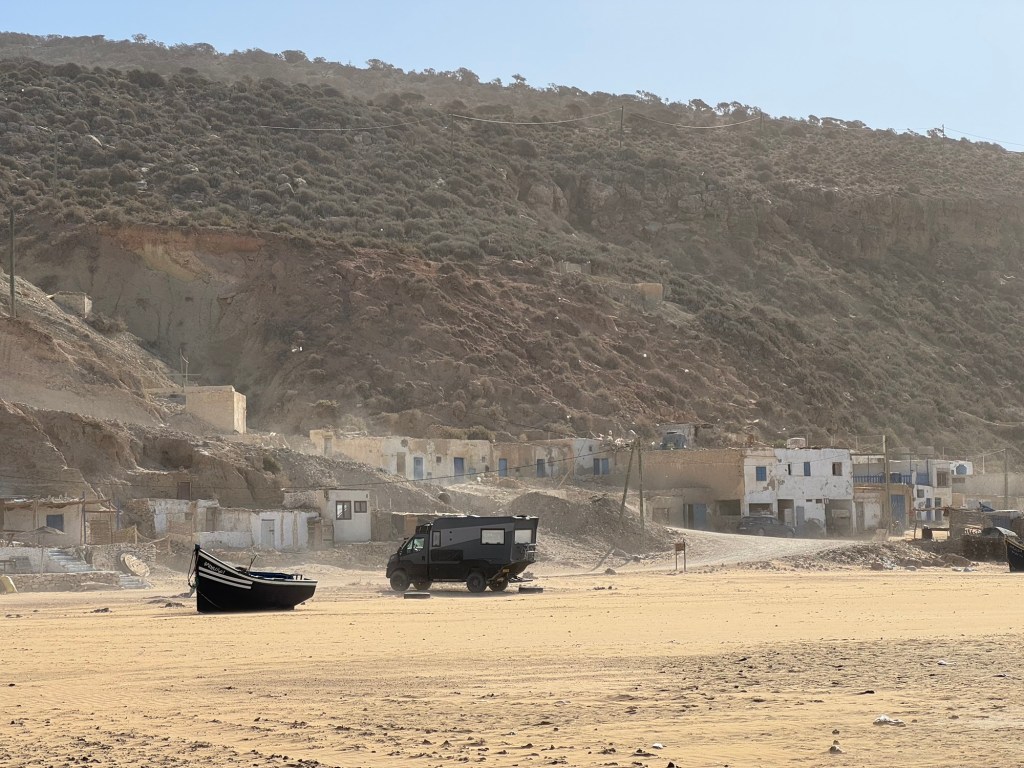
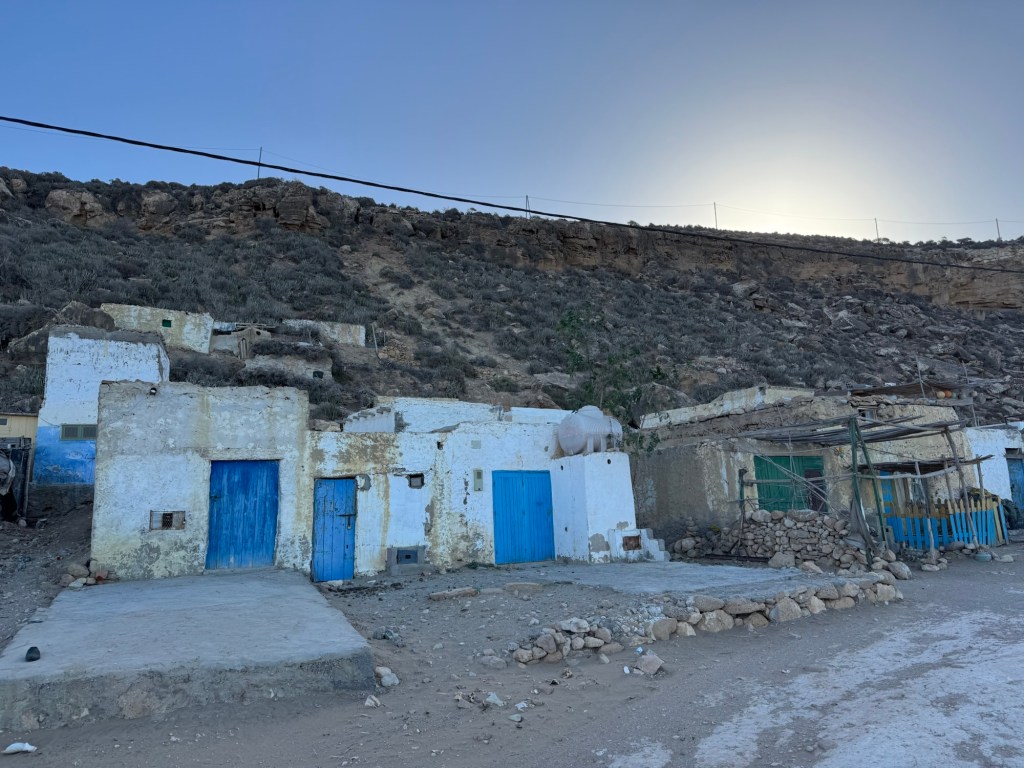
The village was a mix of old mud-brick houses squinting through tiny windows, and single story wooden shacks. There were almost no people in sight.
With the wind rising and the sun lowering we headed for the cafe across the track from us, surprising the owner who’d been listening to some music. He jumped up, beckoned us to seats facing the sea. “Thé de menthe?” He asked. Perfect. It came in a tall silver pot with a plate of home-made biscuits. He poured it from a height into the glasses and went back to his music. A hopeful dog came over and settled down to sleep with its head against my foot. Morocco is full of hopeful dogs.

It struck me that this was Morocco of old: unchanged for generations, low rise, hard to reach and literally off the beaten track. The developers had yet to move in, but when the road was sorted, they probably would. The beach was too good for them to ignore, with a constant crashing surf and wavelets reaching across the sand. We walked along it and watched the sun sink and the sky turn apricot. When we got back to Arnie, the cafe was closed, the owner had vanished. The tide was still coming in, pushing exploratory ripples up the beach towards us to the point that we wondered if we needed to move. But the tideline, marked by the ropey detritus of the fishing fleet seemed a safe distance away.

The wind was blasting the next morning but it was so bright we decided to walk along the cliffs to the next settlements. Ropes of sand blew low across the beach like an army of snakes, fizzing against our shins.
We battled along the shoreline path, heads ringing from the wind and sun. The next settlements were also deserted; single room buildings huddled together, doors padlocked. The wind picked up even further, whipping us with a constant barrage of sand matting our hair, filling our eyes and ears.

Hardly able to see or breathe, we turned back. It was a relief to get back into Arnie and to close the door on the onslaught outside.
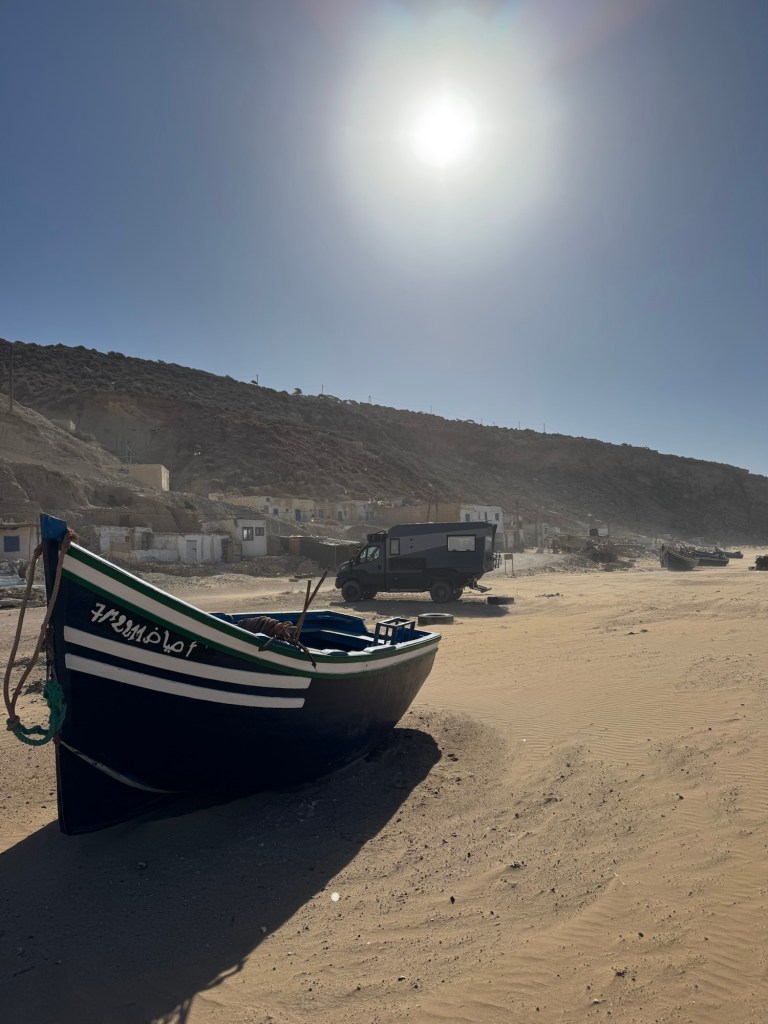
Time to go. Arnie charged up the cliff track and we left Sidi Ahmed to its windy solitude.
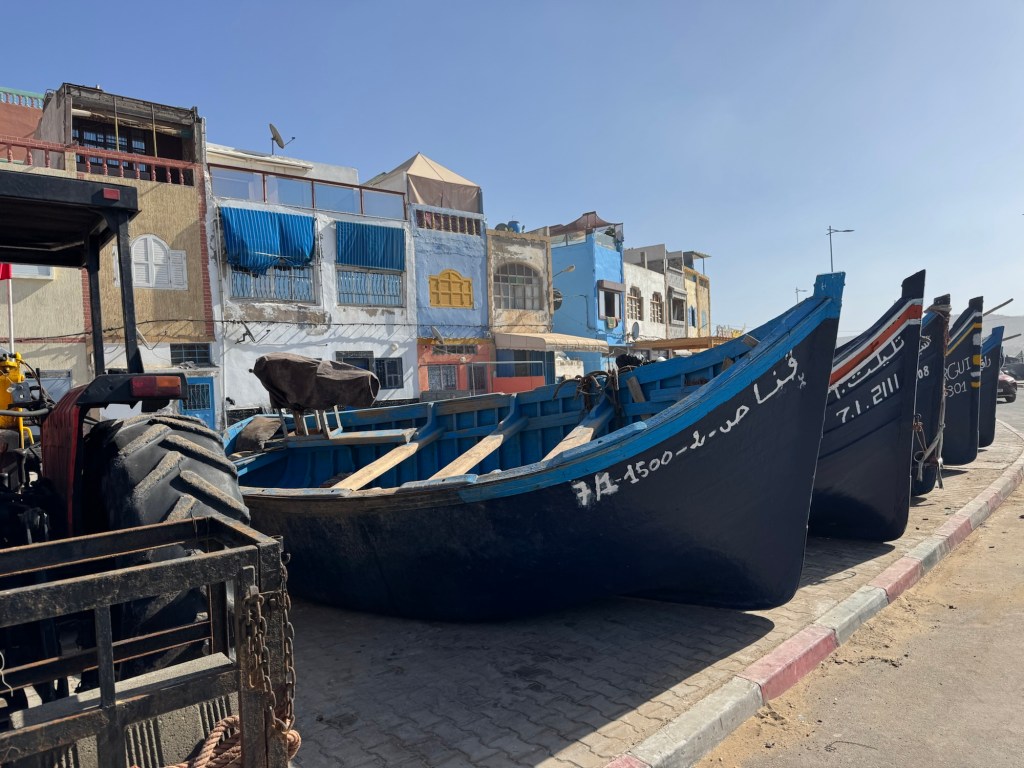
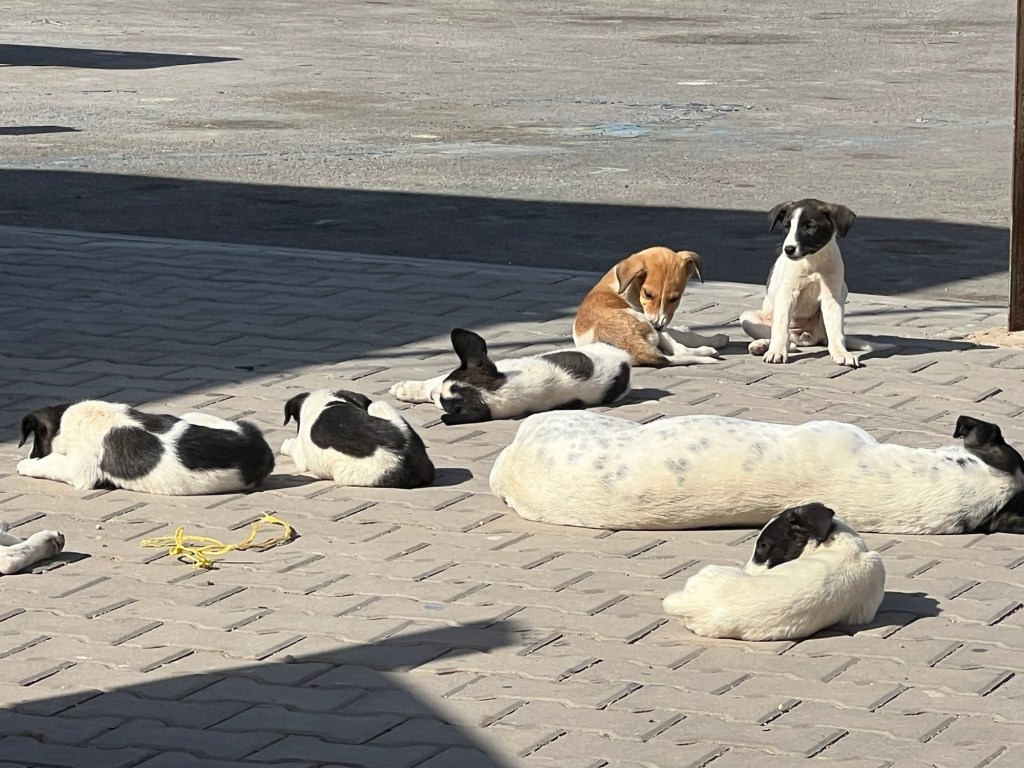
An hour or so later we came to Tafedna; a fishing town full of sleeping dogs lying absolutely everywhere and boats hauled up on the roadside.
We were looking for a farm which apparently allowed people to stay the night. There was a narrow, bumpy diversion around a ruined bridge across the river and we met a harassed-looking couple in a camper coming the other way. The driver wound down his window. “Are you looking for Golden Targante?” Yes we were. “So are we but we can’t see it, and it gets really narrow up there. We’re going back.” We thanked them and let them pass. “Stay safe” he said, nodding seriously at me. There is a slight sense among some visitors to Morocco that they are pioneers in a hostile land, never more than a flat tire away from abduction by armed bandits. They would never say “stay safe” to someone they met on the street at home. But the truth is that nowhere in Morocco feels as edgy as much of London.
The point where the farm was supposed to be was lined with a formidable fence and a closed gate. Two men were chatting in front of it. Was this Golden Targante? “Yes!” Said the shorter of the two men in dungarees and a red baseball cap with a jaunty moustache. “I will open the gate”.
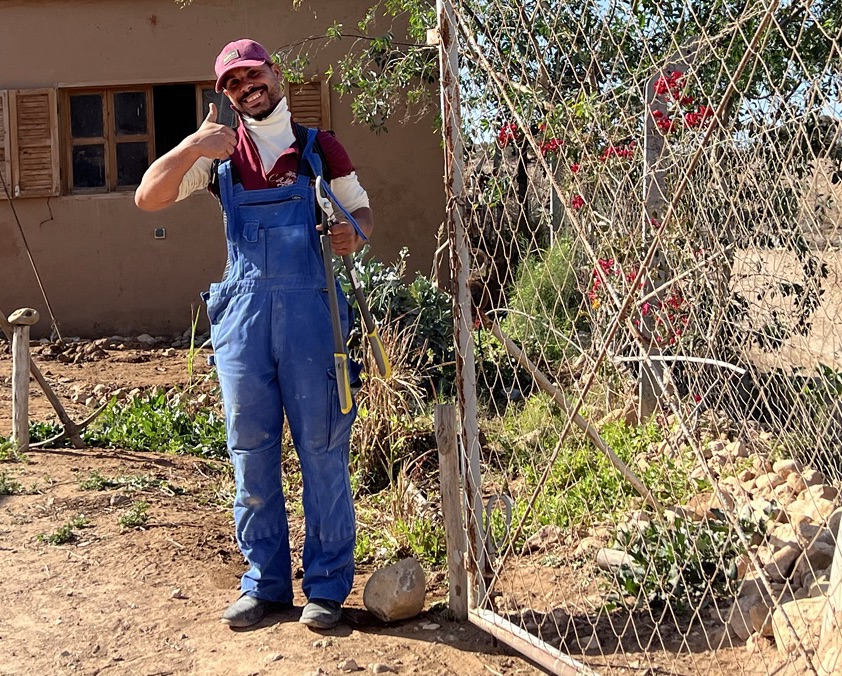
His name was Walid and he ushered us across a bumpy stretch of ground to park outside a low rise building with ill-fitting double-glazed doors. This was a rental building, he said and showed us around. The bathroom was unfinished, with rubble swept into corners and there was an air of desperation about the project which still felt like it was transitioning between building site and campground – in which direction wasn’t entirely clear. Still, it was a peaceful place looking out to the sea and Walid seemed happy to have guests.
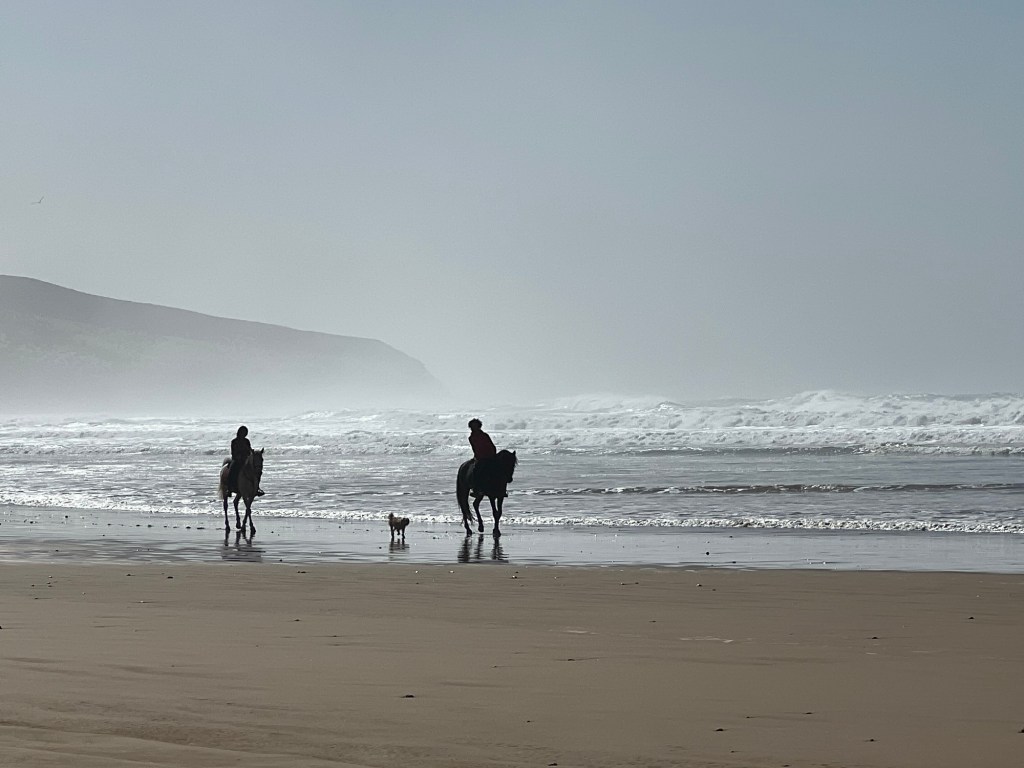
We walked through fields to the sea and found a vast beach, and almost no people. This coastline seems to swallow them up.
That evening there was a knock on Arnie’s door and Walid surprised us with a chicken tagine and fresh bread. This is the sort of thing that happens in Morocco. People without much to start with, readily offering food and drink to complete strangers. He left it with us and went back to his little house by the front gate.
The next morning, it happened again. Another knock, and there was Walid with a pot of coffee, a stack of flatbreads and another tagine containing a bubbling Berber omelette. We took it to the sitting area by the rental block and I asked him about his life. He had sciatica which made heavy work difficult and he seemed to be relying on volunteers for the work on his campground which he said had started three years ago. “I have people come from all over the world to help me” he said. Students from Europe, South America and Australia. He smiled shyly. “I get lonely here on my own” he said. “So I like it when there are people here”. He was keen to get our thoughts about his plans. We told him about our encounter with the frustrated campers and suggested that the first thing he needed was a sign. He nodded at this thoughtfully. I wonder how much will have changed in another three years, but for all of the imperfections in the campsite, everyone reviewing it had given it five stars. The warmth of the welcome is more important than the quality of the plumbing.
Back in Tafedna we sought coffee and discovered a plethora of places selling Instant. Having become slightly addicted to Nus-Nus – literally “half-half” (espresso and milk) – we sought out the only one with a coffee machine. Across the road we spotted Walid who’d come into town “to see some people, otherwise I get lonely”. We needed some supplies so he steered us to a shop the size of a large wardrobe, where we bought discs of bread, dusty oranges, aubergines and tomatoes. We said goodbye all over again to Wahid and he walked back down the road towards his farm, a small figure on the hot pavement, steering a path through the sleeping dogs.
Heading south again the track became ever more adventurous, to the point where we had to lower the tire pressures to keep our fillings in place.
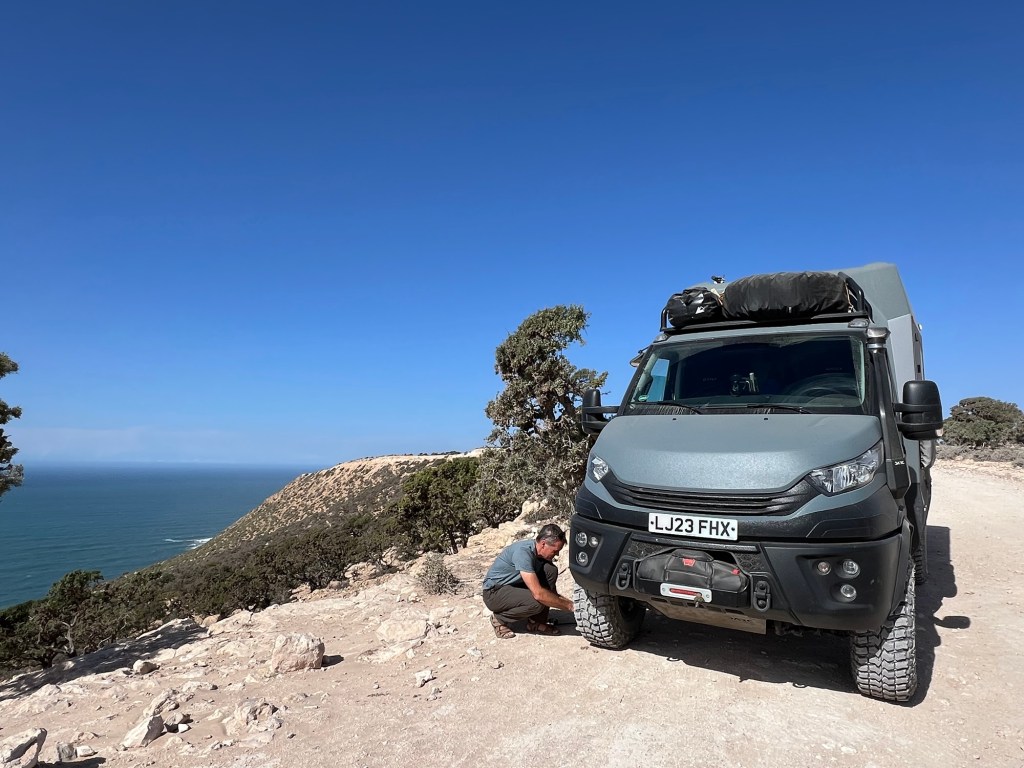
We met a camel herd spilling into the path, all knees, eyelashes and floppy lips.

The further we went, the more lonely it became and the more challenging. The sand got softer and the track more difficult to follow. We walked a section to find our route, feeling that somehow civilisation had drifted off and left us on our own again. We spent the night at the edge of an argan forest in a fearsome wind which threw sticks on the roof.
It all felt very “out there” but it turned out we were just a couple of km from a village. Morocco’s size and wildness is disorientating. Just as you think you have reached wilderness, you discover people making a life there. What for us is exotic and adventurous is just another day at the office for someone else.
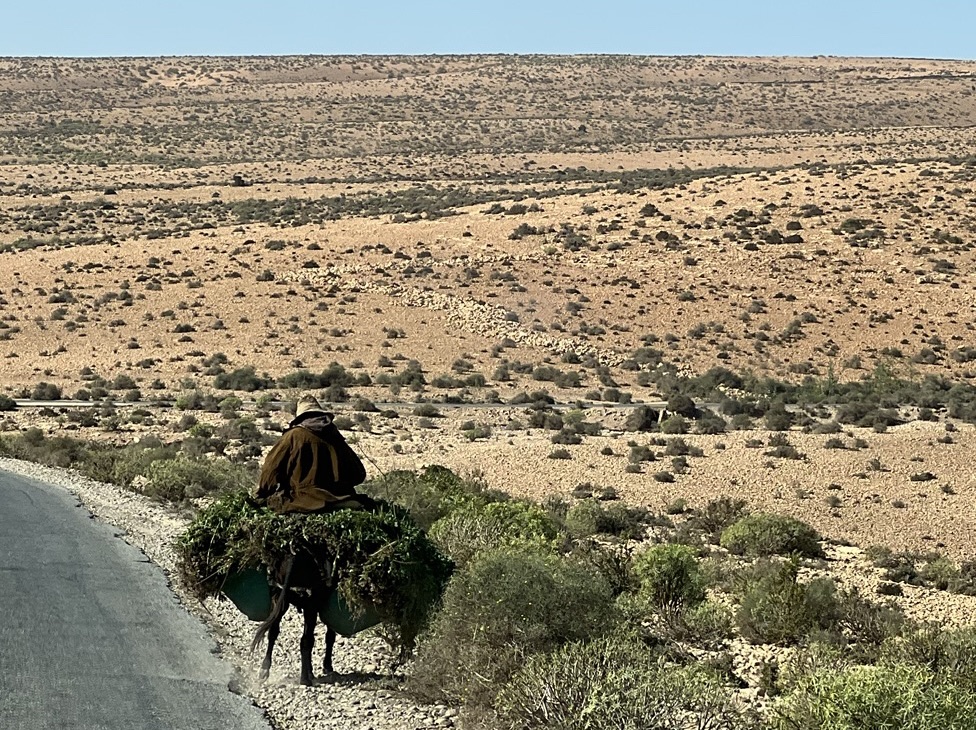
Back on the highway, on the cliffs near Imsouane we pulled into a layby for coffee from a roadside vendor. The guy had a coffee machine bolted into the back of a small van, and a couple of plastic chairs. You see these quite frequently in Morocco and we’ve discovered that they are invariably run by people who take great pride in their coffee; preparing it with frowning concentration, checking pressures and temperature, frothing the milk just so, and anxious that we like what they’ve made. It has always been good. We took our coffees onto a flat area behind the van to look at the view, followed, nonchalantly by two boys with a football who seemed to be with the coffee stall guy. The ball came our way and I kicked it back and then we were having a kickabout in the hot sunshine, which was their plan all along of course. They were such bright, polite lads. Where were we from? Which team did we support? Where were we going?
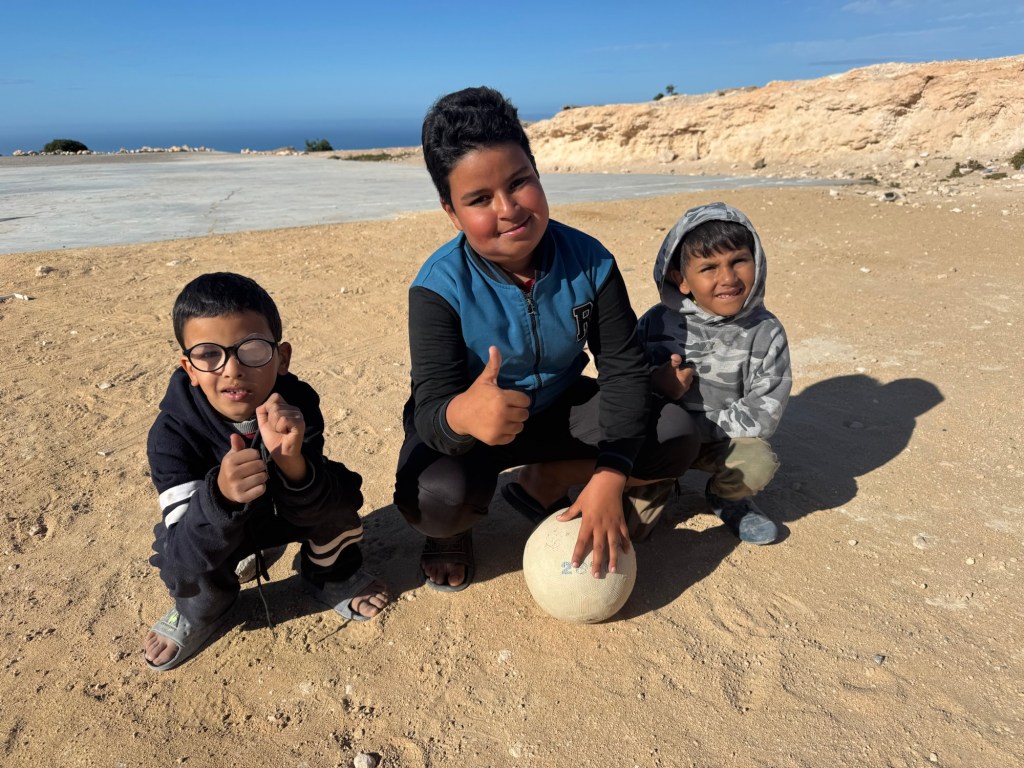
Coffees finished, we pulled back onto the highway exchanging waves with the boys as they became dots in the rear view mirror.
In Agadir, ninety minutes south we found ourselves back among the tourists. We don’t think of ourselves as tourists really. Having arrived in Morocco more than two months ago it now feels like we live here. We feel familiar with the place and its people, food, culture. We are still on the outside looking in of course, and though our few words of Arabic are appreciated, we still have to resort to French or English to be understood so I guess we are still tourists after all. Accordingly, we took the cable car up to the old city walls which still mark the spot where the 16th century incarnation of Agadir was flattened by an earthquake in 1731.
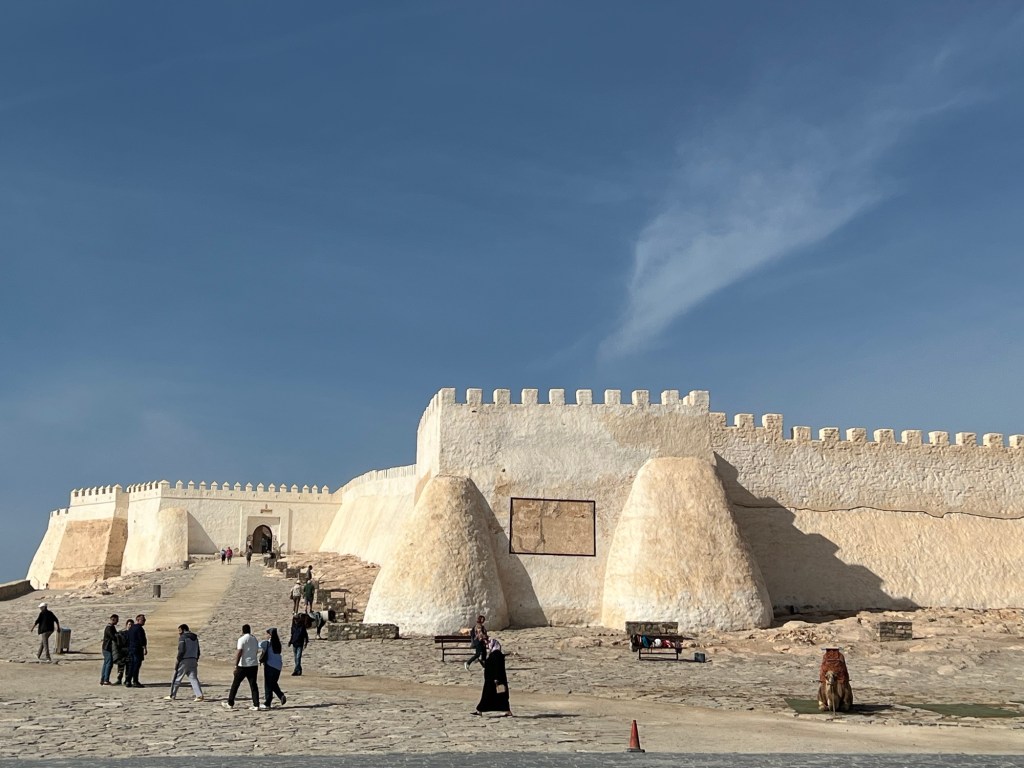
There were donkey rides and knick-knacks to buy of course but we were glad to leave. Not before a visit to an insurance broker though.
We’ve been here long enough that we had to extend Arnie’s insurance (UK insurers no longer cover Morocco). We found the nondescript office block and were immedately ushered into an office which seemed to be entirely staffed by incredibly serious and capable women, who knew exactly what we needed, filled the paperwork, took the money, printed the certificate and sent us on our way within about fifteen minutes. Marvellous.
South of Agadir we took the track again feeling revived by having escaped city life once more.
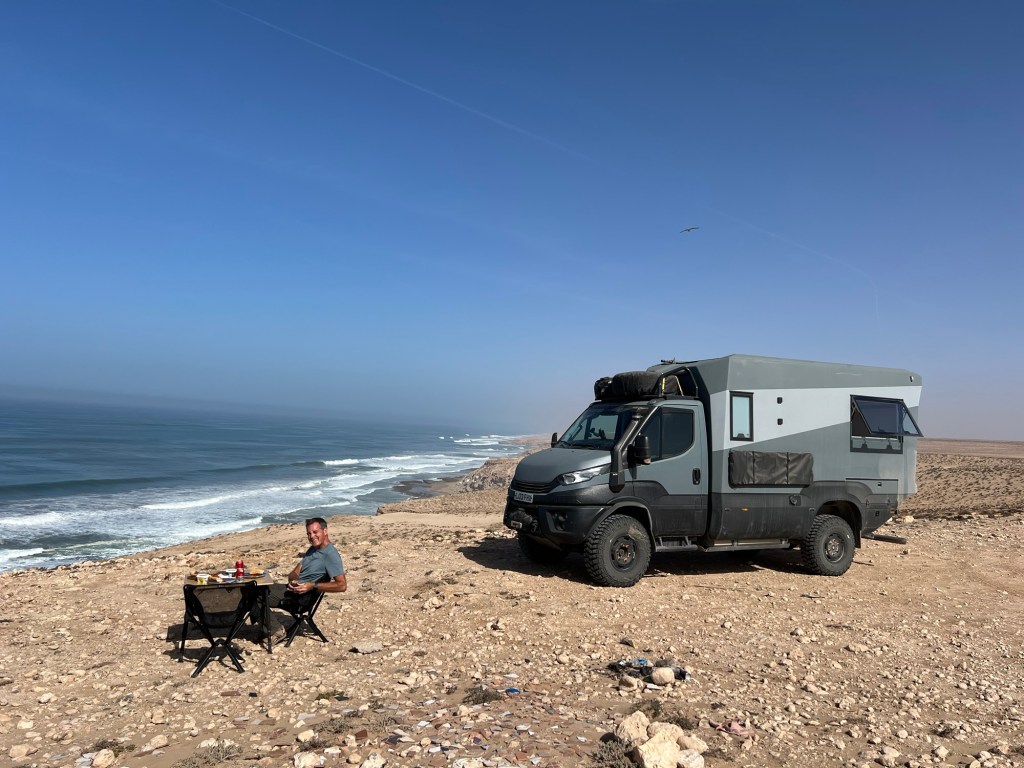
The weather bounced between blazing sunshine and moody lowering clouds, threatening rain even if they didn’t deliver it.

Between Agadir and Sidi Ifni is a string of curious little one horse towns, all so far from Morocco’s main arteries that their efforts to be taken seriously as resorts seem mostly unrewarded.

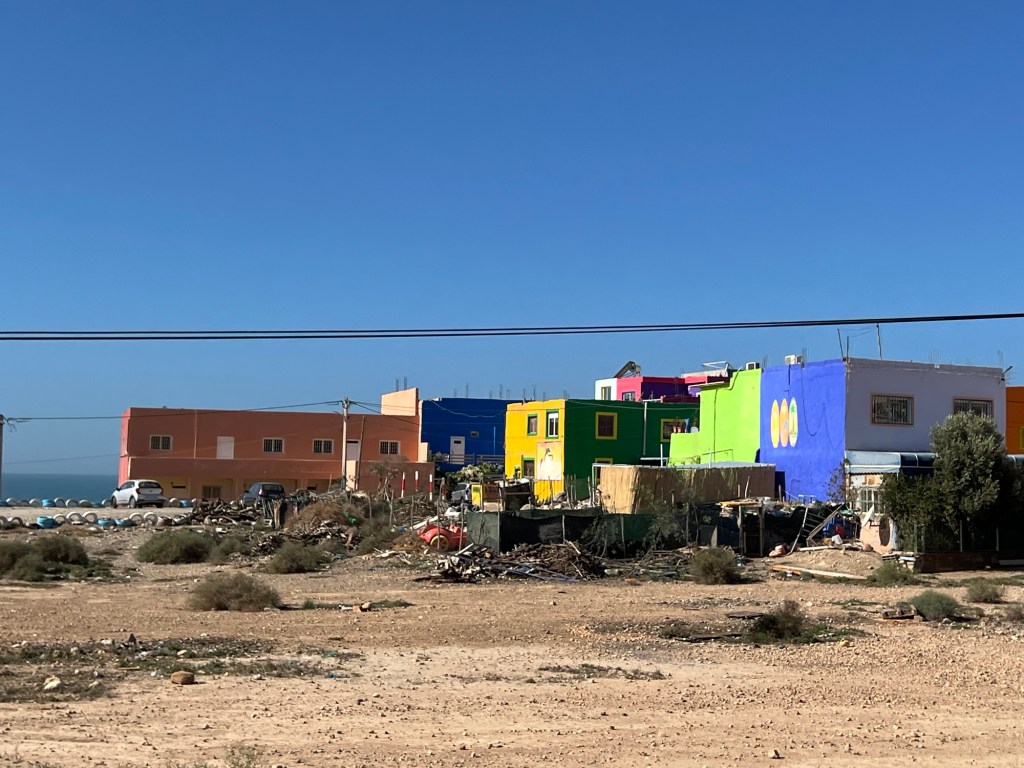
Perhaps they boom at other times of year but in the winter, despite the sunshine, they have the slightly doleful character common to all resorts without people. We pressed on.
Sidi Ifni was actually a part of Spain for more than a hundred years until – after some bloody fighting and considerable international pressure – the Spanish ceded the city back to Morocco in 1969. We were told that Spanish was the second language in the city and while we heard little evidence of that, the Spanish influence was all over the architecture.

The main square in particular was surrounded by buildings built by the Spanish – a cathedral, and former government buildings.
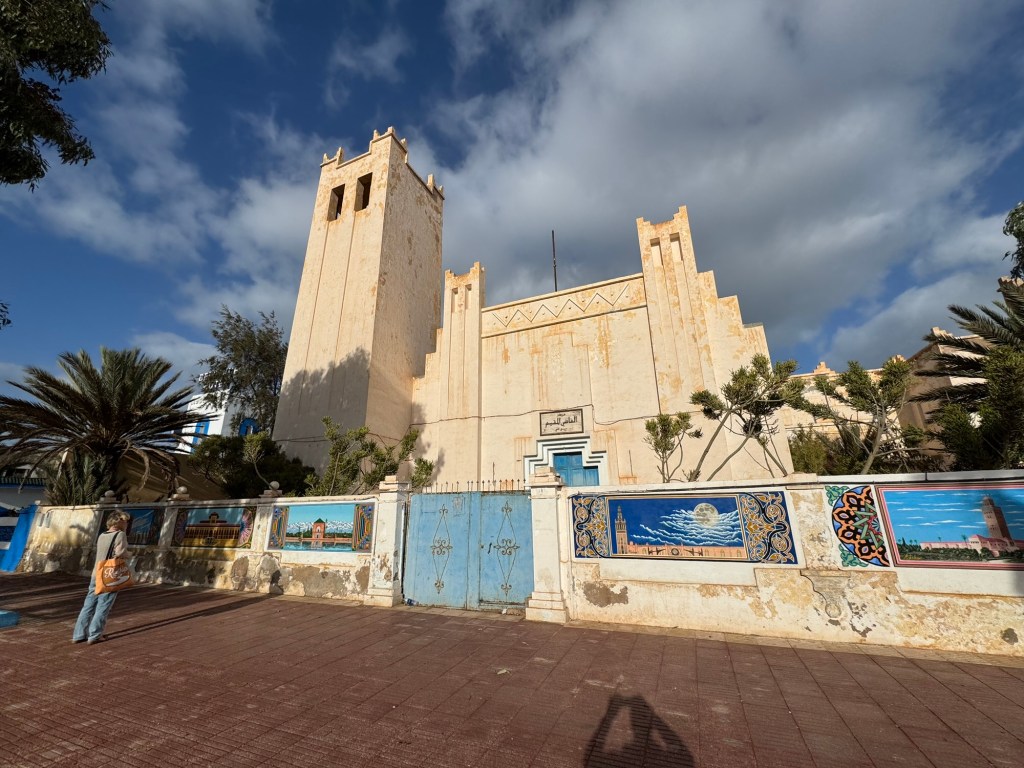
Almost all were now closed up and fenced off. It was clearly a sensitive issue for the Moroccan authorities that the most attractive part of the city was built by the former colonialists. Should they be restored or replaced? The city still feels different from its neighbours with buildings freshly painted in blue and white, setting a jaunty tone.

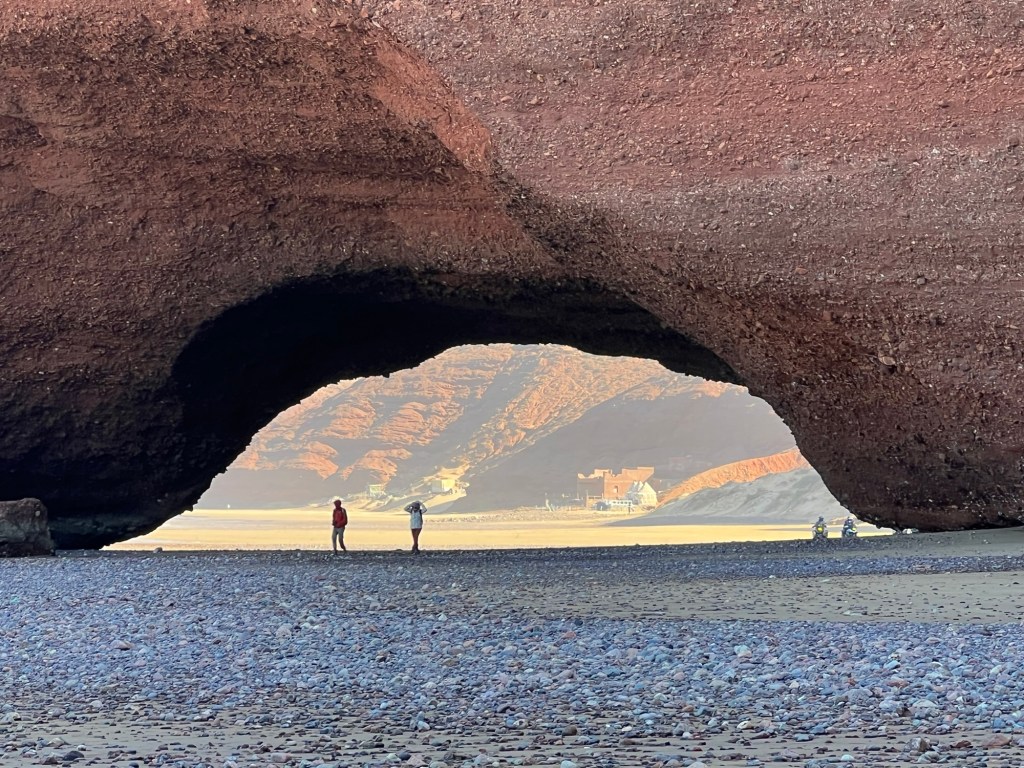
There are some famous rock arches nearby, which proved surprisingly hard to actually get to. One proved impossible to get to as it had collapsed a decade earlier but those which remained made us feel like the specks we are.

It felt like the last stop on our tour of the Atlantic Coast. Western Sahara was still some way further south but we were seeing more Sahrawi people (literally “inhabitants of the desert”) in their distictive pale blue and gold robes, and Touareg men in their brilliant blue turbans (the “cheich”) with the material permanently draped around their noses and mouths to keep any possible sandstorms out. The character of the landscape was changing too. Sandier, dryer, more stark. We were heading back into the desert.

 The Magic Bus
Marvellous! Perfectly describes the desolation. We’re feeling some of th
LikeLiked by 1 person